




Even the strongest equipment lineup can fall short if a system’s architecture is built on assumptions instead of careful planning. A skilled integrator in control system projects brings order to the chaos by ensuring hardware, code, wiring, safety logic, and documentation all work together with predictable consistency. Control system integration isn’t just about assembling components—it’s about eliminating hidden mistakes before they can affect production, stability, or safety.
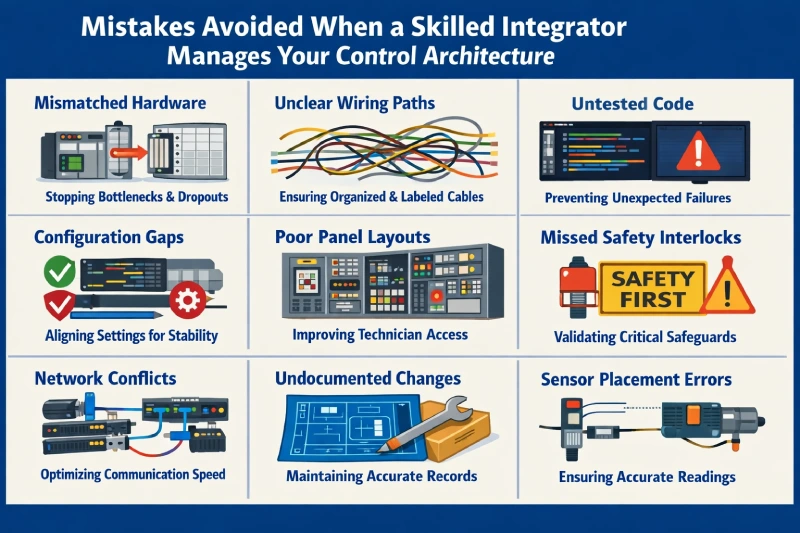
Preventing Mismatched Hardware That Disrupts System Flow
Hardware selection shapes how signals travel, how fast decisions are made, and how reliably the system responds. Process control system integrators evaluate compatibility across controllers, field devices, communication modules, and operator interfaces to prevent bottlenecks. Without this oversight, mismatched hardware can cause data dropouts, unstable loops, and expensive troubleshooting.
Integration teams also coordinate specifications so new devices match existing infrastructure. Control integrators check voltage levels, communication protocols, and mechanical interfaces to avoid conflicts during installation. Their planning ensures smooth system flow instead of forcing operators to work around unpredictable behavior.
Avoiding Unclear Wiring Paths That Cause Troubleshooting Delays
Clean wiring paths reduce downtime by giving technicians visible, organized routes to follow when diagnosing issues. Skilled integration teams design wiring layouts with logic and structure so technicians can trace faults easily. Unclear routing makes even small issues turn into hours of unnecessary searching.
Detailed labels and updated as-built drawings add another layer of clarity. By documenting each termination point, cable run, and signal route, control integrators minimize confusion and allow maintenance staff to solve problems faster without guessing where wires lead.
Eliminating Untested Code That Risks Unexpected Shutdowns
Poorly tested program code can trigger faults, misread sensor values, or shut down equipment unexpectedly. Control system integration teams develop code with structured testing phases that verify alarms, modes, interlocks, and manual functions before deployment. This prevents costly interruptions once the system goes live. Testing doesn’t end with internal reviews. Process control system integrators run simulated conditions, verify transitions between states, and confirm edge-case behavior. This thorough approach builds confidence in system operation and cuts down on commissioning surprises.
Reducing Configuration Gaps That Weaken Process Stability
Configuration gaps occur when devices, software, or communication settings lack full alignment. A skilled integrator in control system environments verifies every configuration detail—from network addresses to PID tuning presets—to maintain stability. Overlooking even one setting can create inconsistent performance or miscommunication.
Adjustments are then fine-tuned for the specific application. Integrators analyze response curves, load variations, and safety tolerances to ensure the system aligns with the intended process behavior. This careful setup prevents drift and reduces operator interventions.
Preventing Poor Panel Layouts That Limit Technician Access
Panel layout affects accessibility, airflow, and long-term maintenance. Poor design forces technicians to reach around live components or dismantle sections just to perform routine work. Control integrators organize panels so devices with frequent service needs sit in easy-to-reach locations.
Cable management also matters. Process control system integrators ensure adequate spacing for heat dissipation, documentation pockets, grounding requirements, and expansion potential. Thoughtful panel design protects technicians and prolongs the life of the equipment.
Avoiding Missed Safety Interlocks in Critical Operations
Safety interlocks protect equipment, personnel, and operations. Missing or misconfigured interlocks expose systems to dangerous conditions, especially in hazardous processes. Skilled control system integration teams review interlock logic carefully to ensure every critical condition triggers the correct response.
These interlocks are validated through structured testing. Integrators confirm each safety event—pressure spikes, temperature limits, emergency stops—results in predictable and safe outcomes. This prevents accidents and strengthens compliance with industry safety standards.
Reducing Network Conflicts That Slow Communication Speeds
Industrial networks rely on precise addressing, bandwidth allocation, and device prioritization. A poorly designed network can slow down communication or cause intermittent failures. Control integrators map out switches, VLANs, and communication paths to prevent signal collisions and bandwidth overload.
Diagnostics are used to identify potential bottlenecks before they become disruptive. Process control system integrators evaluate traffic patterns, redundancy settings, and protocol compatibility to ensure rapid communication across all devices. This keeps control loops responsive and operator stations updated in real time.
Preventing Undocumented Changes That Create Long-term Issues
Undocumented changes—whether accidental or intentional—make future troubleshooting much harder. Skilled integration teams maintain revision control on drawings, code, and configurations so every update is traceable. This transparency protects against confusion during audits or repairs.
Documentation also protects system integrity during staff turnover. Control system integration teams create clear records so new technicians understand why changes were made and how they affect future modifications. This continuity prevents inconsistent updates that could weaken performance.
Eliminating Sensor Placement Errors That Distort Readings
Sensor accuracy depends heavily on placement. Poor positioning exposes sensors to vibration, turbulence, or temperature swings that distort readings. Integrator in control system projects analyze process flow, environmental factors, and mounting angles to determine optimal placement.
Correct placement ensures faster response times and more accurate data. Process control system integrators verify each sensor’s role and environment so that readings reflect true process conditions instead of noise. Accurate sensing supports better control decisions and reduces operator overrides. Skilled integration teams help organizations avoid these costly mistakes by managing architecture, documentation, testing, and long-term system behavior with precision. RL Consulting delivers structured control system integration services that keep operations stable, safe, and scalable for future needs.