




A dishwasher can make everyday kitchen cleanup much easier, but like any household appliance, it can eventually develop mechanical problems. One component that may require attention is the dishwasher pump. If the pump becomes worn, blocked, or fails completely, the dishwasher may not drain properly or may stop operating as expected.
Replacing a dishwasher pump can be a manageable repair for someone with suitable tools and basic mechanical skills. However, proper preparation and careful handling are important before starting the job.
Understand the Dishwasher Pump
The pump is an important part of the dishwasher’s water circulation and drainage system. Depending on the appliance design, the pump may help move water through the spray system or remove used water from the machine.
Before purchasing a replacement, identify the exact dishwasher model and check the manufacturer’s parts information. Pumps can differ significantly between models, so using the correct replacement component is essential.
Gather the Necessary Tools
Having the required tools available before starting can make the repair much easier. Depending on the dishwasher model, you may need screwdrivers, pliers, a wrench, towels, a container for water, and the replacement pump.
It is also useful to keep the appliance’s manual nearby. The manufacturer’s instructions can provide model-specific information about accessing internal components and removing the existing pump.
Disconnect the Dishwasher
Safety should always come first when working on an electrical appliance. Turn off the dishwasher and disconnect its power supply before beginning the repair.
If the dishwasher is hardwired rather than connected through a standard plug, switch off the appropriate circuit breaker. You should also shut off the water supply if the repair requires access to water connections.
Never work on the appliance while it is connected to an active power source.
Remove the Lower Access Components
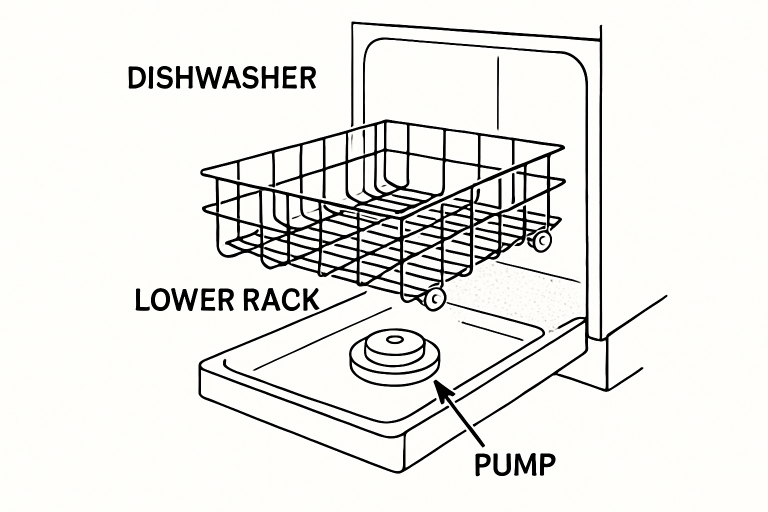
Open the dishwasher and remove the lower rack to create enough working space. Depending on the model, you may also need to remove the filter, spray arm, or lower access panel.
Keep screws and small components organized as you remove them. Taking photographs during disassembly can also help you remember where individual parts belong when it is time to reassemble the appliance.
Locate and Remove the Old Pump
Once the relevant components have been removed, locate the pump assembly. You may need to disconnect electrical connectors, hoses, clamps, or mounting hardware before the pump can be removed.
Work carefully when disconnecting hoses because water may remain inside the system. Place towels or a shallow container underneath the work area to catch any remaining water.
Avoid pulling forcefully on wires or connectors. If a component does not release easily, check whether an additional clip, screw, or retaining mechanism is holding it in place.
Install the Replacement Pump
Compare the replacement pump with the original component before installation. Check that the connections, mounting points, and overall design match.
Position the new pump according to the manufacturer’s instructions and secure it using the appropriate mounting hardware. Reconnect the hoses and electrical connections carefully, making sure each connection is properly seated.
Loose connections can result in leaks or electrical problems, so take time to inspect everything before moving to the next step.
Reassemble the Dishwasher
Once the new pump is installed, reinstall the components that were removed during disassembly. Replace filters, spray arms, access panels, racks, and other parts in their original positions.
Check that nothing has been left inside the dishwasher and that all screws and fasteners are secure.
Before restoring power, inspect the visible hoses and connections for signs of damage or incorrect installation.
Test the Dishwasher
Restore the water supply and reconnect the dishwasher to its power source. Run a short cycle and observe the appliance carefully.
Listen for unusual noises and check underneath and around the dishwasher for leaks. Pay attention to whether water circulates and drains normally.
If the dishwasher still does not operate correctly, switch it off and investigate the issue rather than continuing to run it.
When to Call a Professional
Replacing a dishwasher pump may be straightforward on some models but considerably more complicated on others. If the appliance is hardwired, difficult to access, or showing electrical problems, professional assistance may be the safer choice.
A qualified appliance technician can also help when the pump is not the actual cause of the problem. Issues involving control boards, wiring, sensors, or other components can produce symptoms similar to a failed pump.
Final Thoughts
Replacing a dishwasher pump requires careful preparation, the correct replacement part, and attention to safety. Disconnecting power, following the appliance manufacturer’s instructions, installing the pump correctly, and testing for leaks are all important parts of the process.
If you are comfortable performing basic appliance repairs, the job may be manageable with the right tools and instructions. When there is uncertainty about electrical connections or the cause of the problem, however, getting professional help can prevent further damage and unnecessary risk.