




Any electric bike’s performance highly depends on how its components work together, such as battery, controller, motor, and more. Many people think an electric bike is the combination of a motor attached to a bicycle, that’s it, but there is a lot more going behind for the effective functioning of an e-bike, which we will discuss in detail in today’s article, so keep reading.
The Role of Each Component
Each component of an e-bike plays an integral role in its functioning, such as:
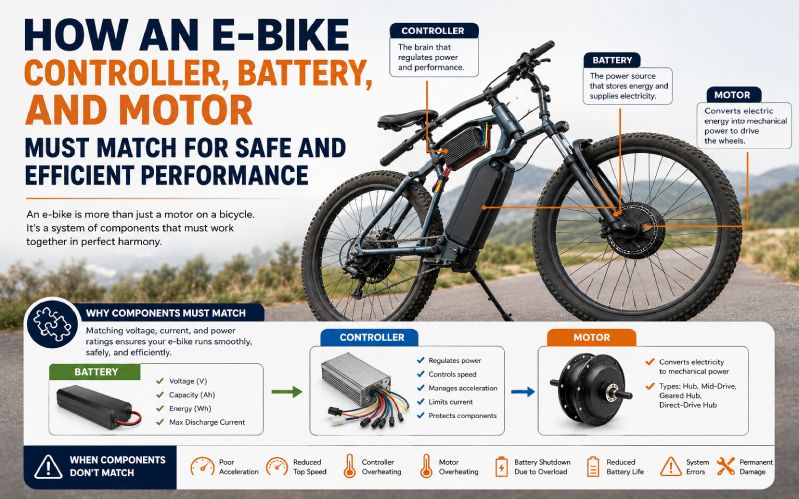
Battery
It works as the storage system which stores electricity and supplies power to the controller when needed.
Key specifications include:
- Voltage (V)
- Capacity (Ah)
- Energy (Wh)
- Maximum discharge current
Controller
The controller acts as the “brain” of the e-bike. It handles tasks like:
- Regulating power from the battery
- Controlling motor speed
- Managing acceleration
- Limiting current
- Protecting electrical components
Motor
The motor is used to convert electric energy into mechanical power to operate wheels.
Common motor types include:
- Hub motors
- Mid-drive motors
- Geared hub motors
- Direct-drive hub motors
Why Voltage Must Match
Voltage compatibility is a crucial factor to look after before taking anything into consideration.
For example:
- A 36V battery should typically be paired with a 36V controller and motor.
- A 48V system should use components designed for 48V operation.
- A 52V battery is generally used with controllers that can safely support that voltage.
If you use a battery with a voltage higher than the controller’s rating, it can damage electronic components; in contrast, a lower voltage can reduce performance by preventing the system from operating efficiently.
Matching the Controller’s Current Rating
Controllers are measured by the maximum current they can deliver.
For example:
- 15A controller
- 20A controller
- 25A controller
- 35A controller
It is important to choose the right option to ensure each component is working efficiently.
Motor Power Ratings Matter
E-bike motors are commonly rated at:
- 250W
- 500W
- 750W
- 1,000W
- 1,500W or higher
Your motor’s power rating should match the controller’s power output. Both oversized and undersized controllers are not good and should be avoided.
Battery Capacity vs. Battery Voltage
Battery capacity and battery voltage are different, for example:
- A larger Ah rating increases riding range.
- Voltage primarily affects power delivery and motor performance.
If you increase battery capacity, it will allow you to go on longer rides on a single charge.
What Happens If Components Don’t Match?
Every component must align with each other; otherwise, it can create problems like:
- Poor acceleration
- Reduced top speed
- Controller overheating
- Motor overheating
- Battery shutdown due to overload
- Reduced battery lifespan
- System error codes
- Permanent component damage
How to Check Compatibility
Before upgrading or replacing parts, verify:
- Battery voltage matches the controller.
- Controller voltage matches the motor.
- The battery can supply the controller’s maximum current.
- Motor power rating is suitable for the controller.
- Connectors and wiring are compatible.
- Manufacturer specifications support the intended combination.
Tips for Upgrading an E-Bike
If you’re planning an upgrade:
- Upgrade components as a complete system when necessary.
- Purchase compatible parts from reputable manufacturers.
- Avoid exceeding the controller’s voltage limits.
- Monitor motor temperature after significant power upgrades.
- Use appropriate wiring and connectors.
- Follow the manufacturer’s installation recommendations.
Frequently Asked Questions (FAQs)
Can I Use a Higher-Voltage Battery with My Existing Controller?
It depends on your controller’s compatibility, whether it is designed to support higher voltage or not. You should check it before proceeding.
Does a Larger Battery Make an e-bike Faster?
No, a larger battery doesn’t make an e-bike faster, it is an indication of storage capacity. A large battery will help you cover a longer distance in a single charge.
Can a Powerful Controller Damage a Smaller Motor?
Yes, a powerful controller can damage a smaller motor which is not made for handling higher power.
Conclusion
An e-bike is made of several components, and it is crucial to align them perfectly for an efficient functioning of an e-bike. In today’s article, we discussed this topic in detail and shared relevant information with you. In the end, we hope that you liked reading it and will share your feedback with us.